
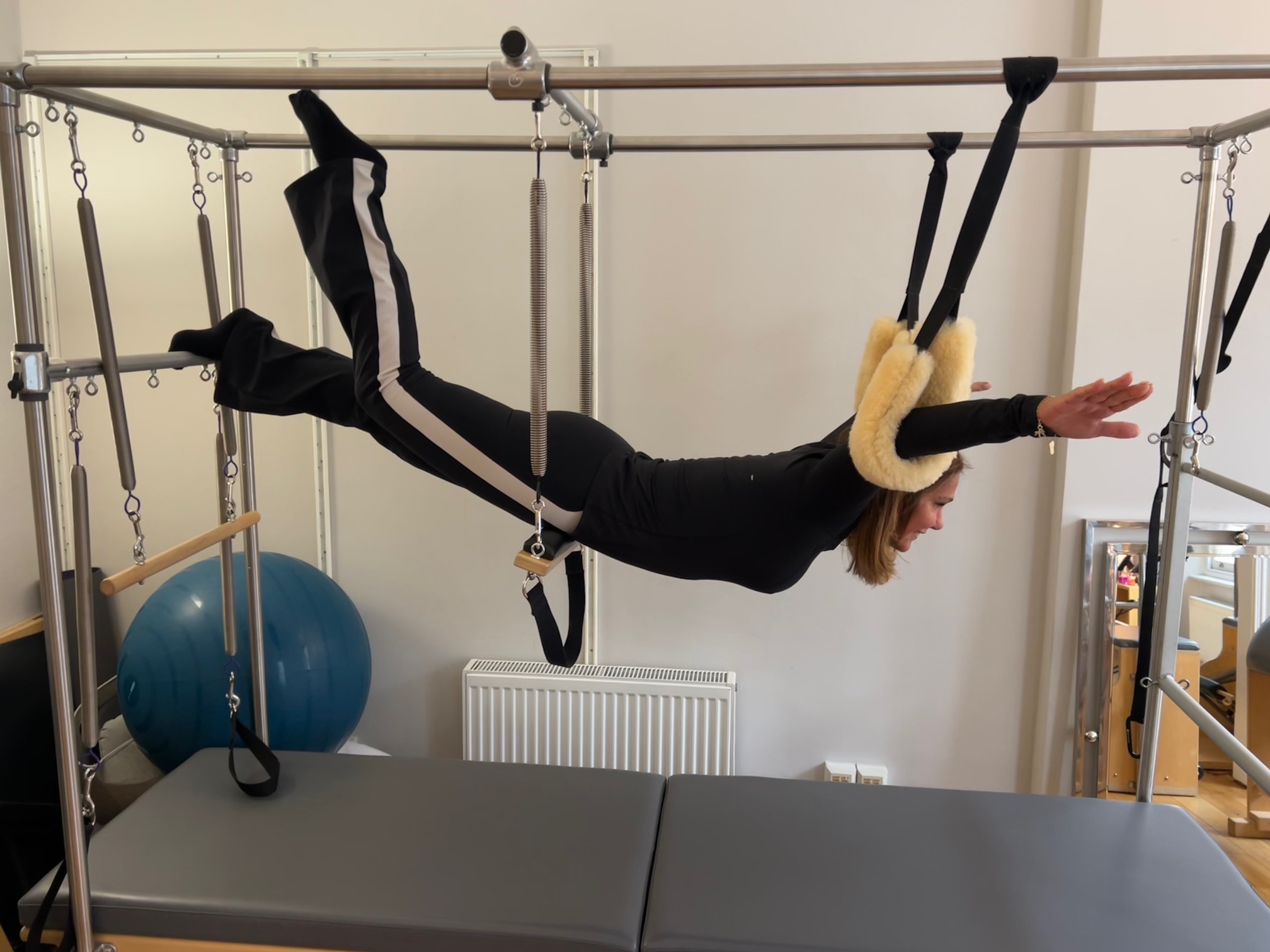
Created by Joseph Pilates, the method was originally called Contrology—a name that reveals its true essence: the conscious control of body and mind working as one.
In today’s world, Pilates stands at the intersection of classical discipline and modern rehabilitation. It serves elite athletes, dancers, pregnant women, seniors, people in pain, and those recovering from injury. It is one of the few movement systems capable of adapting to every body, at every stage of life.
What makes Pilates timeless is not only the equipment or the exercises, but the principles that govern every movement.
The principles of Pilates are: centering, control, coordination, breathing, balance, precision, and flow — together creating true mind–body connection.
They are not just technical guidelines, but a language the nervous system understands. Through them, movement becomes intelligent, intentional, and healing.
• Centering brings awareness to the core, where power originates.
• Control teaches the body to move with purpose rather than impulse.
• Coordination integrates the whole body into unified action.
• Breathing oxygenates tissues and regulates the nervous system.
• Balance restores symmetry between strength and mobility.
• Precision refines movement so every action has meaning.
• Flow transforms exercise into a continuous, graceful experience.
When these principles are honored, Pilates becomes more than fitness—it becomes therapy.
In clinical and physical-therapy contexts, Pilates offers something rare: a bridge between rehabilitation and performance. It retrains the body after injury, corrects dysfunctional movement patterns, and restores trust in motion. For those living with chronic pain, scoliosis, hypermobility, post-surgical limitations, or neurological conditions, Pilates provides safety with progression—structure with freedom.
Unlike repetitive gym routines, Pilates educates. It teaches clients how to move, how to breathe, how to listen. It creates awareness where there was disconnection, strength where there was fear, and fluidity where there was rigidity.